 İlklerin Başkenti,
Kralların Sonsuz İstirahatgahı:
KAUNOS
“Kaunos, yalnızca bir antik kent değil…bir kavşak noktasıdır.
“Kaunos is not merely an ancient city… it is a crossroads.”
BÖLÜM-1
BİR KENTİN YENİDEN DOĞUŞU.
PART ONE
THE BEGINNING:
THE REBIRTH OF A CITY
Sunucu: Kaunos’un keşif ve kazı süreci nasıl başladı?
Presenter: How did the discovery and excavation of Kaunos begin?
Doç. Dr. Ufuk Çörtük:
Kaunos, ilk olarak 1840 yılında İngiliz Rd. Hoskyn tarafından lokalize edilerek bilim dünyasına tanıtılmıştır. Kent üzerine ilk araştırmaları başlatan ve sürdüren yerli araştırmacı ise Prof. Dr. Baki Öğün’dür.
Nitekim Kaunos’taki ilk kazı çalışmaları da 1966 yılında yine Baki hocamız tarafından başlatıldı. Kendisi, 2001 yılındaki vefatına kadar kesintisiz 35 yıl boyunca kazı başkanı olarak görevine devam etti.
Benim de hocam olan Prof. Dr. Cengiz Işık, hocası Baki Öğün ile yıllarca Kaunos’ta beraber çalıştıktan sonra onun vefatının ardından kazı başkanlığını devraldı ve çalışmaları 2020 yılına kadar sürdürdü.
2021 yılı itibariyle de Cengiz hocamızın bir öğrencisi olarak, Kaunos kazı çalışmalarını ben devraldım ve yürütmeye devam ediyorum.
Bugün birçok araştırmacının katıldığı kazı ekibimizle birlikte çalışmalarımızı adeta uluslararası bir atölye ortamında sürdürüyoruz.
Kaunos’ta yürüttüğümüz bilimsel çalışmalar, T.C. Kültür ve Turizm Bakanlığı ile Kültür Varlıkları ve Müzeler Genel Müdürlüğü’nün; Kazılar Dairesi Başkanlığı ve Geleceğe Miras Projesi Dairesi Başkanlığı aracılığıyla sağladığı destekle ilerliyor.
Bu tür uzun soluklu araştırmalarda bu destekler gerçekten önemli bir zemin oluşturuyor. Sağlanan imkânlar hem alanın korunmasına hem de daha sağlıklı verilerle çalışmamıza katkı sunuyor. Bu vesileyle, emeği geçen tüm kurumlara teşekkür etmek isterim.
Assoc. Prof. Dr. Ufuk Çörtük:
Kaunos was first identified and introduced to the academic world in 1840 by the British explorer R. Hoskyn. The first Turkish scholar to initiate and continue research on the city was Prof. Dr. Baki Öğün.
Indeed, the first excavations at Kaunos were launched by Professor Baki Öğün in 1966. He served continuously as the director of the excavations for 35 years, until his death in 2001.
My own professor, Prof. Dr. Cengiz Işık, worked alongside his mentor, Baki Öğün, at Kaunos for many years. Following Professor Öğün’s death, he assumed the directorship of the excavations and continued the work until 2020.
In 2021, as one of Professor Cengiz Işık’s students, I took over the Kaunos excavations and have continued to lead them ever since.
Today, together with our excavation team, which includes researchers from many different fields, we carry out our work in an environment that resembles an international research workshop.
Our scientific work at Kaunos is progressing with the support of the Ministry of Culture and Tourism of the Republic of Türkiye and the General Directorate of Cultural Heritage and Museums, provided through the Department of Excavations and the Department of the Legacy for the Future Project.
Such support provides an essential foundation for long-term research of this kind. The resources provided contribute both to the preservation of the site and to our ability to work with more reliable data. I would therefore like to express my gratitude to all the institutions that have contributed to this work.
“Kaunos artık yalnızca bir kazı alanı değil… yaşayan bir bilim atölyesidir.”
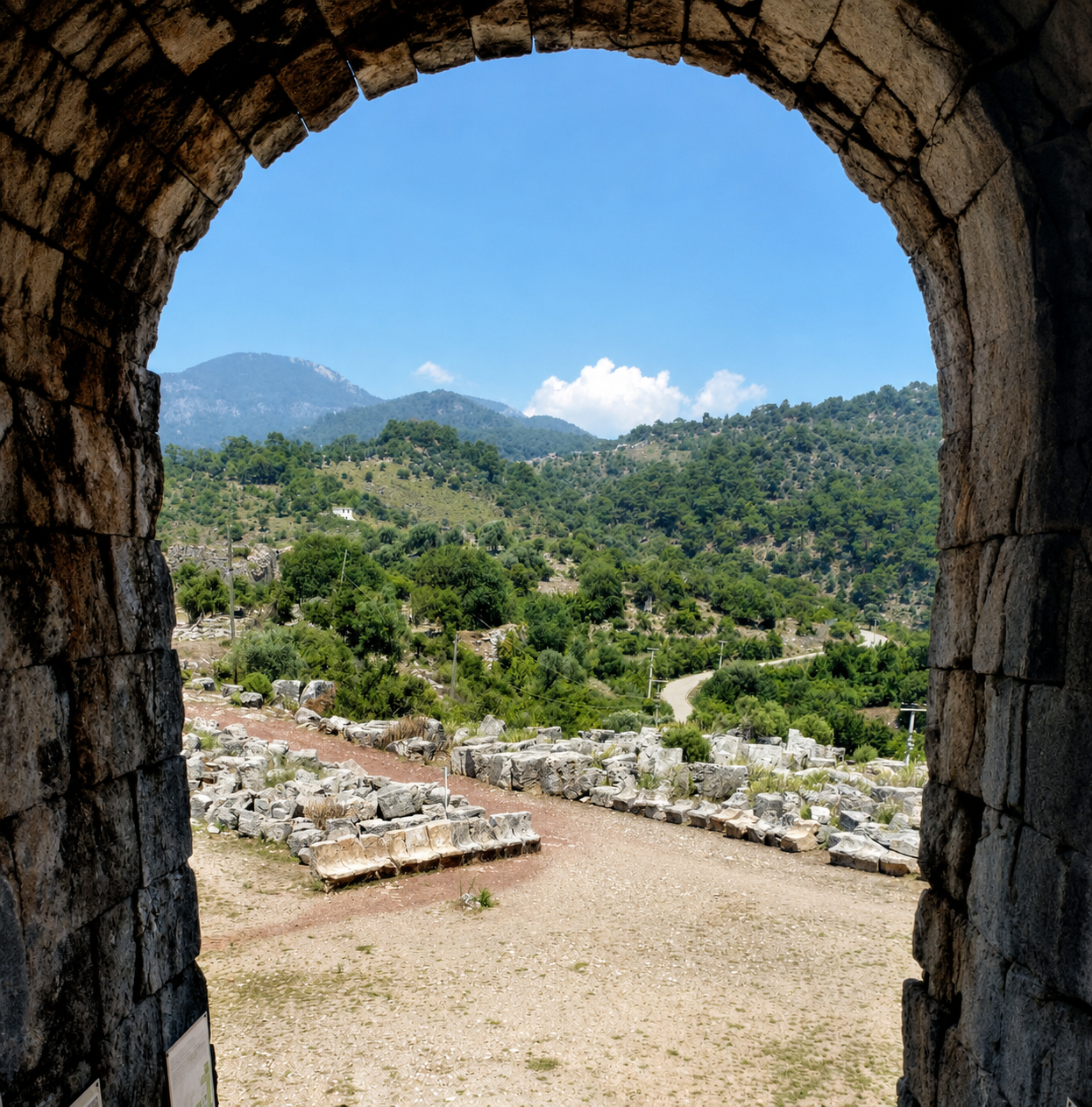
“Kaunos is no longer merely an excavation site… it is a living scientific workshop.”
Sunucu: Likya–Karia sınırındaki konumu kentin kimliğini nasıl şekillendirdi?
Doç. Dr. Ufuk Çörtük:
Kaunos aslen bir Karia kentidir. Ancak tam da Karia ve Likya sınırında yer almaktadır.
Sırtını Karia’ya dayamış, yüzünü Likya’ya çevirmiş bir kent desek yanlış olmayacaktır.
Bu tanım, ilk bakışta basit bir yön tarifidir gibi görünür.
Oysa aslında Kaunos’un bütün kimliğini, bütün tarihsel karakterini içinde barındıran güçlü bir ifadedir.
Çünkü burada yalnızca iki coğrafya yan yana gelmez…
İki ayrı kültür dünyası, iki farklı yaşam biçimi, iki ayrı düşünme biçimi iç içe geçer.
Her iki bölgenin de kültürünü her anlamda bu kentte görmekteyiz.
Bu birliktelik mimaride kendini gösterir.
Presenter: How did its location on the Lycian–Carian border shape the identity of the city?
Assoc. Prof. Dr. Ufuk Çörtük:
Kaunos is essentially a Carian city. However, it is situated precisely on the border between Caria and Lycia.
It would not be wrong to describe it as a city with its back against Caria and its face turned toward Lycia.
At first glance, this description may seem like a simple indication of direction.
In fact, however, it is a powerful statement that encompasses the entire identity and historical character of Kaunos.
Because here, it is not merely two geographical regions that come together…
Two distinct cultural worlds, two different ways of life, and two different ways of thinking become intertwined.
We can observe the cultures of both regions in every aspect of this city.
This coexistence manifests itself in the architecture.
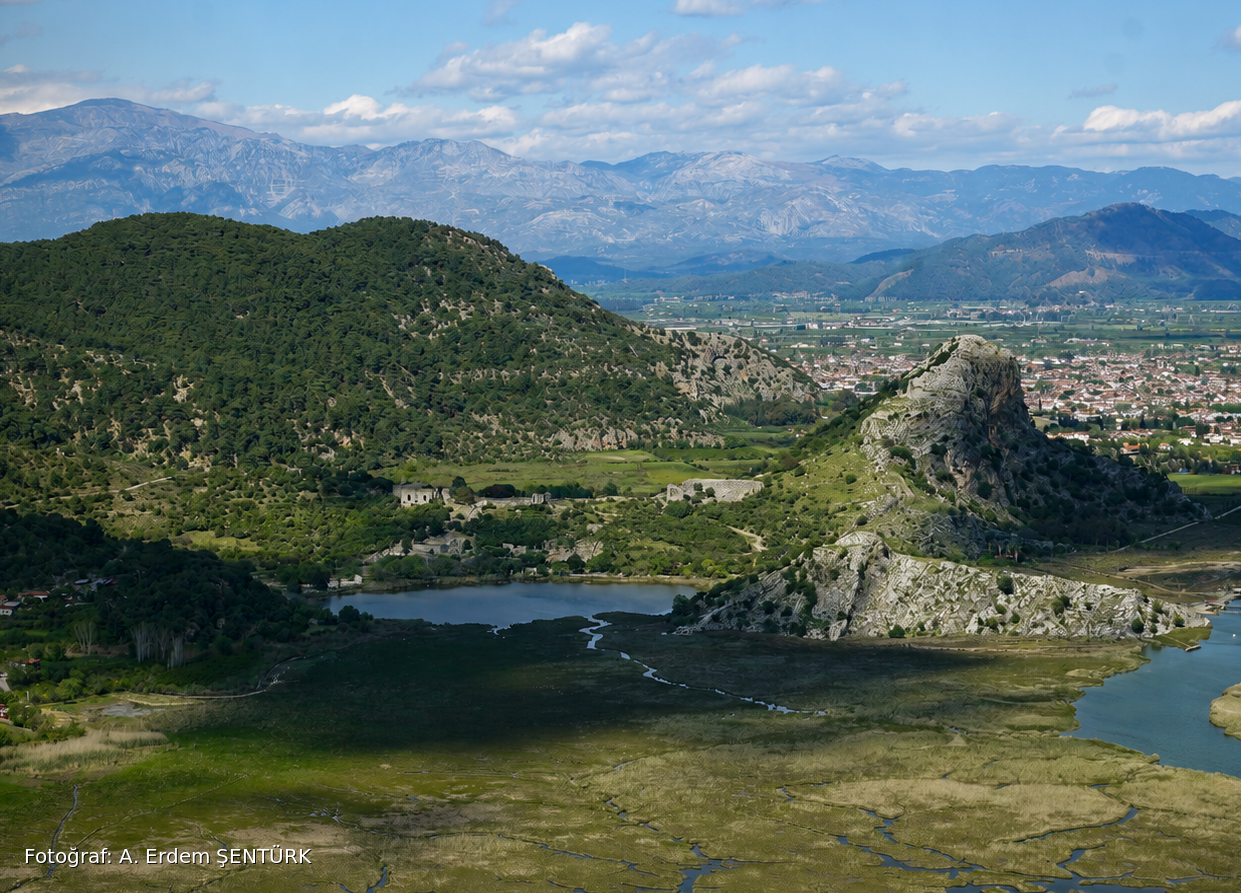
“Sırtı Karia’da, yüzü Likya’da bir kent”
“A city with its back to Caria and its face turned toward Lycia”
Doç. Dr. Ufuk Çörtük: Yerleşiminde, taşın işlenişinde, kent planlamasında iki farklı geleneğin izlerini aynı andaokuyabilirsiniz.
İnanç sistemine baktığınızda bu geçiş daha da belirgin hale gelir.
Anadolu’nun ana tanrıça geleneğini temsil eden inanç unsurları ile Akdeniz dünyasına ait tanrılarve kültler aynı kentte yan yana değil, iç içe yaşar.
Gündelik yaşamda ise bu durum daha doğal bir biçimde hissedilir.
Ticaret, üretim, liman hareketliliği…
Kaunos, yalnızca bir yerleşim yeri değil, aynı zamanda bir karşılaşma alanıdır.
İç bölgelerden gelen ürünler burada denizle buluşur.
Deniz yoluyla gelen etkiler burada Anadolu’ya karışır.
Bu yüzden Kaunos sadece bir liman değildir.
Aynı zamanda bir geçiş kapısıdır.
Ama belki de daha doğru ifade şudur:
Kaunos bir sınır kenti değildir.
Çünkü sınır, iki şeyi ayırır.
Kaunos ise ayırmaz… birleştirir.
Assoc. Prof. Dr. Ufuk ÇÖRTÜK: In the arrangement of the buildings, the workmanship of the stone, and the planning of the city, you can observe traces of two distinct traditions simultaneously. When you examine the belief system, this transition becomes even more apparent.
Religious elements representing Anatolia’s Mother Goddess tradition coexist with the gods and cults of the Mediterranean world—not merely side by side, but deeply intertwined within the same city.
In everyday life, this coexistence is felt in a more natural way. Trade, production, the activity of the harbor…
Kaunos is not merely a settlement; it is also a meeting place. Products arriving from the inland regions meet the sea here.
Influences arriving by sea merge with Anatolia here. For this reason, Kaunos is not merely a harbor city.
It is also a gateway. But perhaps a more accurate way of putting it is this:
Kaunos is not a border city.
Because a border separates two worlds.
Kaunos does not separate them… it brings them together.
“Kaunos’ta iki kültür yan yana durmaz… birbirinin içine geçer.”
“In Kaunos, two cultures do not merely exist side by side… they become intertwined.”
Ksantos Üç Dilli Yazıtı
Likya’nın başkenti Ksantos’ta bulunan ve yaklaşık MÖ 400’e tarihlenen stel; Likçe, Milyanca ve Grekçe olmak üzere üç dilde yazılmıştır.
Pers egemenliği dönemine ait yazıt, bölgenin çok kültürlü yapısının önemli kanıtlarından biridir.
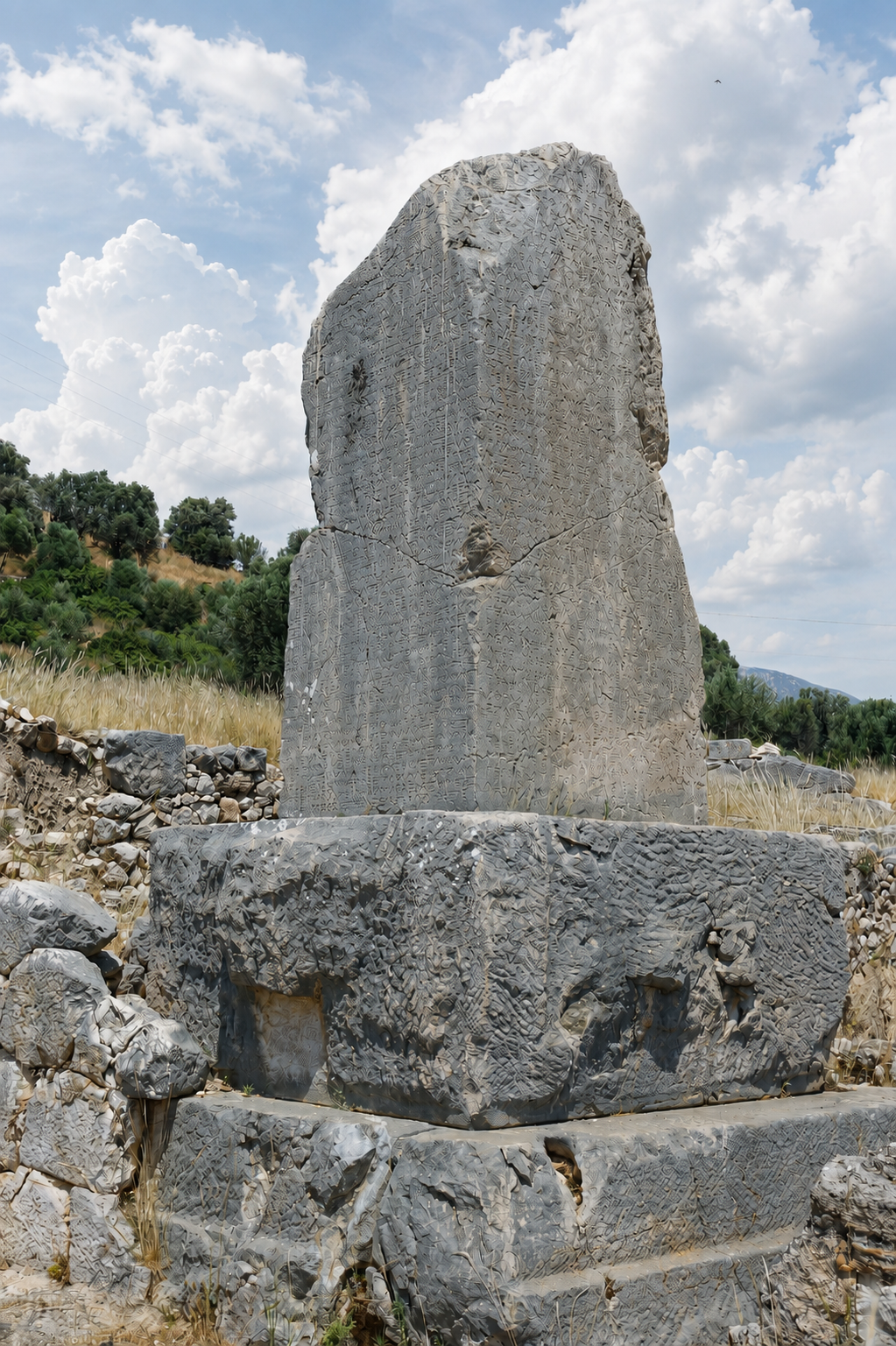
The Trilingual Inscription of Xanthos
Discovered in Xanthos, the capital of Lycia, and dating to around 400 BCE, the stele bears inscriptions in three languages: Lycian, Milyan, and Greek.
Dating from the period of Persian rule, it provides important evidence of the region’s multicultural character.
Doç. Dr. Ufuk ÇÖRTÜK: Bu çok katmanlı yapı yalnızca antik dönemle sınırlı değildir.
Zaman değişir, siyasi yapılar dönüşür, egemen güçler farklılaşır…
Ama Kaunos’un bu “geçiş kimliği” varlığını sürdürmeye devam eder.
Hatta Hierokles’ten, Kaunos’un Bizans döneminde de bir Likya kenti olarak anıldığınıöğrenmekteyiz.
Bu bilgi son derece önemlidir.
Çünkü bize şunu açıkça gösterir:
Kaunos’un kimliği sabit değildir.
Dönemlere göre yeniden tanımlanır, dönüşür, farklı katmanlar kazanır.
Ama hiçbir zaman tek bir kültüre ait olmaz
“Kaunos tek bir kimliğe ait değildir. Kültürlerin kesiştiği bir geçiş alanıdır.”
Assoc. Prof. Dr. Ufuk Çörtük: This multilayered character is not limited to antiquity.
Times change, political structures evolve, and ruling powers shift…
Yet Kaunos continues to preserve this “transitional identity.”
Indeed, we learn from Hierocles that Kaunos was still referred to as a Lycian city during the Byzantine period.
This information is extremely important,
because it clearly demonstrates the following:
The identity of Kaunos is not fixed.
It is redefined and transformed over time, acquiring new layers in different periods.
Yet it never belongs exclusively to a single culture.
“Kaunos does not belong to a single identity. It is a crossroads where cultures converge.”
KAUNOS’U DİĞER ANTİK KENTLERDEN AYIRAN NE?
WHAT SETS KAUNOS APART FROM OTHER ANCIENT CITIES?
“Arkeolojide bir ilkler kenti” “A City of Archaeological Firsts”
Sunucu: Kaunos’u diğer antik kentlerden ayıran en belirgin özellik nedir?
Doç. Dr. Ufuk Çörtük:
Arkeoloji bilimine kattığı ilkleridir.
Bu ilkler, Kaunos’un son derece özgün ve eşsiz buluntularında kendini gösterir.
Karca’nın, daha doğrusu Kaunosca’nın çözümünde bugüne kadarki tek anahtar olan “Çift Dilli Stel” gibi;
kentin cadde ve sokaklarının rüzgâr yönüne göre planlanmasında kullanılan “Ölçüm Platformu / Gözlem Evi” gibi;
gemi̇cilere iyi yolculuklar ve tüccarlara bol kazançlar ihsan eden tanrıça Aphrodite Euploia’ya ait“Kutsal Oda” gibi;
limanın karalaşmaya başlaması nedeniyle çökme eğilimi gösteren ekonomiyi yeniden canlandırmakamacıyla alınmış yeni “Gümrük Nizamnamesi” gibi;
Ana Tanrıça’nın — yani Matar’ın, yani Kybele’nin — bir ağaç gövdesi görüntüsünü çağrıştıransteline “ev” olan “Kutsal Kaya Odası” gibi;
baş tanrısı Basileus Kaunios’un kutsal taşı “Baitylos” gibi;
“Adak Kumbarası” gibi;
ve son yıllarda gün yüzüne çıkarılan “Tuzla” ile antik çağın döner perde sistemi “Periaktos” gibibuluntular…
Bu buluntuların hemen hepsi arkeoloji biliminin birer ilki olma özelliği taşır.
“Kaunos, yalnızca bir kent değil, arkeoloji tarihinde bir dönüm noktasıdır.”
Özellikle bu ilkler arasında;
“Ölçüm Platformu”, “Çift Dilli Stel”, “Tuzla” ve “Periaktos”
arkeoloji bilimi açısından ayrı bir yere sahiptir.
Çünkü bu buluntular, yalnızca bir kentin tarihini değil…
antik dünyanın işleyişini, düşünce biçimini ve yaşam düzenini anlamamıza doğrudan katkı sağlar.
Presenter: What is the most distinctive feature that sets Kaunos apart from other ancient cities?
Assoc. Prof. Dr. Ufuk Çörtük:
The archaeological firsts it has contributed to the field.
These firsts are embodied in the highly distinctive and unique finds uncovered at Kaunos.
The “Bilingual Stele,” which remains the only key discovered so far to deciphering Carian—or, more precisely, Kaunosian;
the “Surveying Platform / Observatory,” used to plan the city’s streets and thoroughfares according to wind direction;
the “Sacred Chamber” dedicated to the goddess Aphrodite Euploia, who granted sailors safe voyages and merchants abundant profits;
the new “Customs Regulations,” introduced to revive the declining economy as the harbour began to silt up and turn into dry land;
the “Sacred Rock Chamber,” which housed the stele of the Mother Goddess—Matar, or Kybele—whose form evokes the trunk of a tree;
the “Baetyl,” the sacred stone of the city’s chief deity, Basileus Kaunios;
the “Votive Offering Box”;
and the “Saltworks” and the ancient rotating stage-screen system known as the “Periaktos,” both unearthed in recent years…
Nearly all these discoveries represent archaeological firsts.
“Kaunos is not merely an ancient city; it represents a turning point in the history of archaeology.”
Among these archaeological firsts, the “Measuring Platform,” “Bilingual Stele,” “Saltworks,” and “Periaktos” hold a particularly significant place in the field of archaeology.
For these discoveries illuminate not only the history of a single city…
but also directly contribute to our understanding of how the ancient world functioned, how its people thought, and how they organized their lives.
YUVARLAK YAPI:
BİR GÖZLEM PLATFORMU
THE CIRCULAR STRUCTURE:
AN OBSERVATION PLATFORM
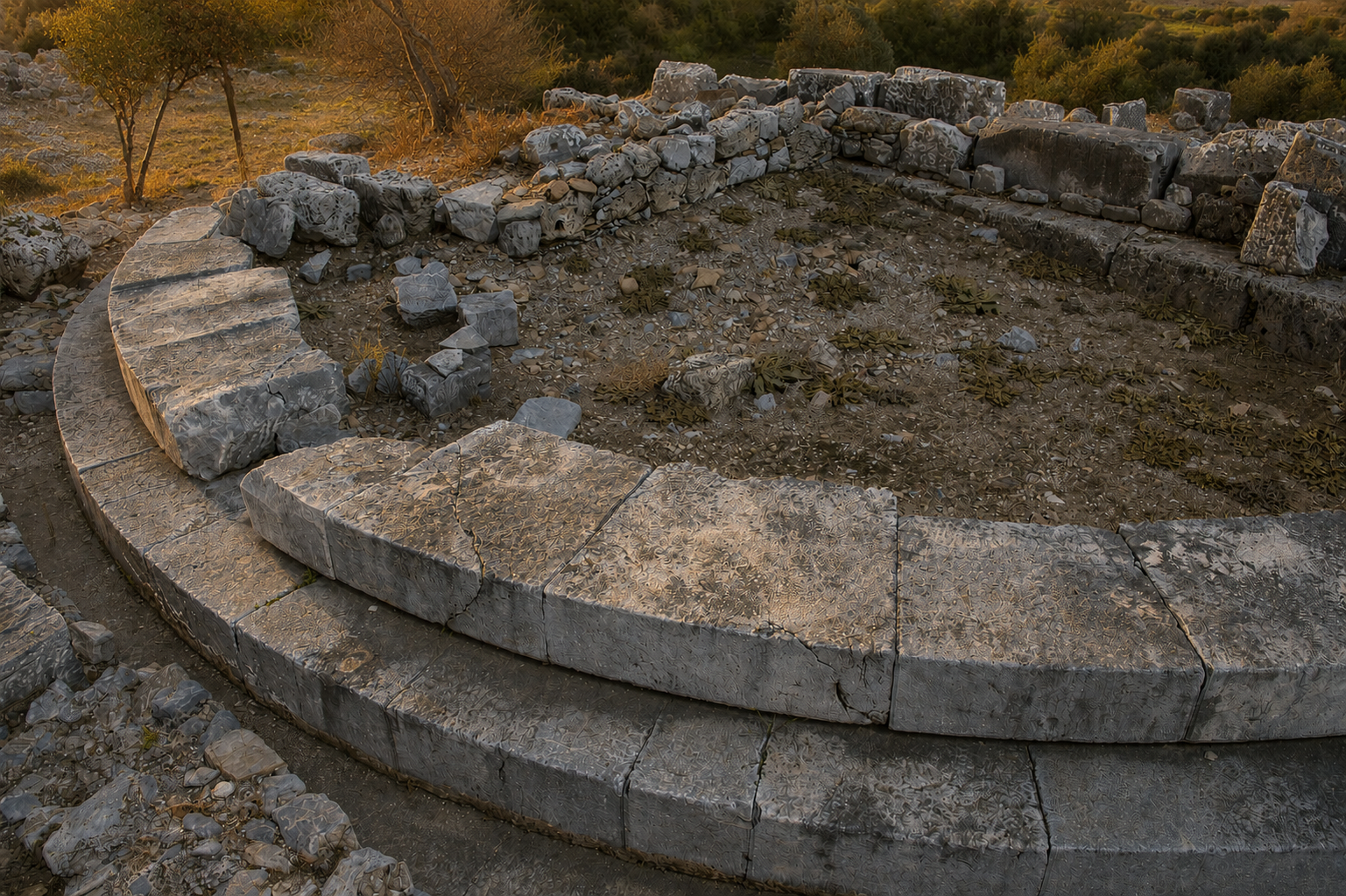
Sunucu: Hocam, daha önce Kaunos’un arkeoloji bilimine kattığı ilklerden bahsederken “ÖlçümPlatformu”na da değinmiştiniz. Bu platform tam olarak ne işe yarıyordu ve antik kentin ticaret düzenindeki önemi nedir?
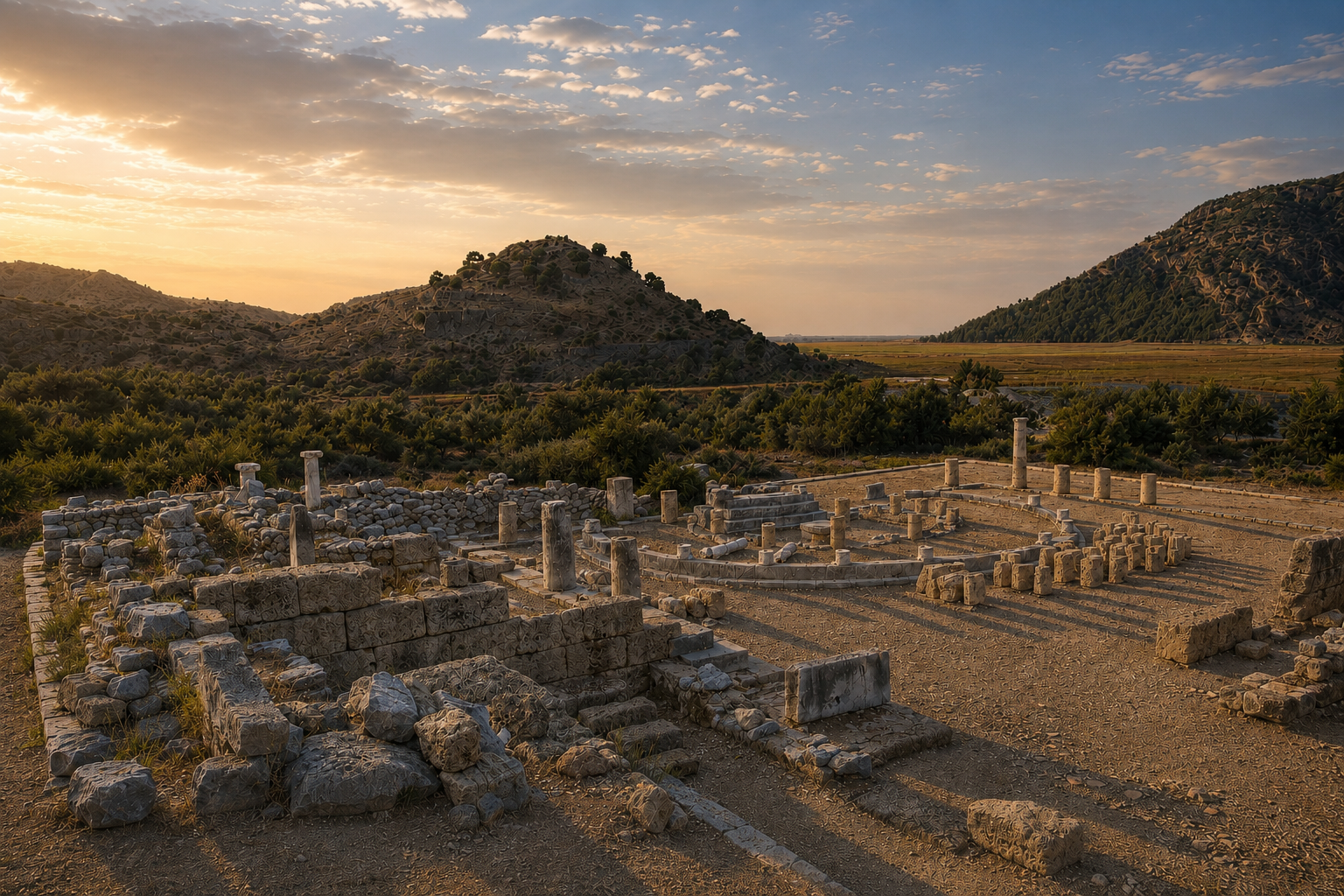
Tiyatro’nun hemen kuzeybatısında lokal mermerden inşa edilmiş üç basamaklı etkileyici biryapıdır. En alt basamak 15.8; orta basamak 14.8 ve üst basamak da 13.75 metre çapındadır. Yan veüst yüzleri özenle tıraşlanmış olan bloklar, birbirleriyle kenet ve dübellerle bağlanmışlardır. Hafifpürüzlü cephe yüzleri ince ve perdahlanmış bir kenar çerçevesi ve altta iki damlalık profillezenginleştirilmiştir. Temel yapısında ele geçen damgalı bir amphora kulpu, yapının inşasının en geçİÖ. 2. yüzyılın ortalı olabileceğini ortaya koymaktadır. Üç basamaklı bu güçlü yuvarlak kalıntınınnasıl bir mimari dokunun alt yapısı olabileceği sorusunda ilk akla gelen cevap, bir Tholos. Ancakbasamakların en üst sırasına ait blokların yüzey detayları biraz daha dikkatle incelendiğinde farkedilecektir ki, burada bir üst yapının varlığından söz edilemez. Çünkü, üst basamak bloklarıtamamen düz tıraşlanmış ve parlatılmıştır; üzerinde bir üst yapının varlığına işaret edecek ne birdübel yuvası vardır ve ne de bir anathyrosis izi. Ayrıca her üç basamağın yükseklikleri de farklıdır. Yukarıdan aşağıya: 41.5, 41.8 ve 43.3 cm. Bu bağlamda diyebiliriz ki, basamaklar adım atarakçıkılan bir fonksiyona hizmet etmemektedir. Aksine, üzerinde rahatça oturulabilecek bir genişliğede sahiptir. Daha da önemlisi; üst sıranın blokları, altındaki sıranın basamak blokları üzerine üçtebirlik bölümüyle oturtulmuş olduğudur ki, diğer üçte ikilik kısım, arkada, toplama kireç taşı blokve küçük taş parçaları ile topraktan oluşan zayıf bir dolgu üzerine yerleştirilmiştir. İşte bütün bunedenlerden dolayı, kaide karakterindeki bu krepis yapının üzerine ne Tholos ve ne de Monopteros benzeri her hangi bir yuvarlak yapının inşa edildiği söylenemez. Nitekim bu üst sıra basamakbloklarında alt bloklarla bağlantılı olarak çoğu zaman dübel de kullanılmamıştır ve ayrıca kendiaralarında kenetle de birbirlerine bağlanmamışlardır.
Üst basamak blokları üzerinde belirlenen bütün bu detayların yanında çok özel bir detay daha gözlemlenmiştir: Geometrik bir ağ. Özenli linear çizgilerle oluşturulmuş bu geometrik ağ, derinlikleri farklı paralel iki dairesel çizgi ile daireyi 16 eşit sektöre ayıran ve her biri 22.5 dereceden geçen radyal çizgiler ve de dairenin radyal çizgilerle kesiştiği noktalarda yer alan tanjantçizgilerden meydana gelmiştir. Daire, radyal ve tanjant çizgilerden oluşan bu geometrik ağın kendiiçindeki ince kurgusu, anakaya üzerine oturtulmuş temel bloklar üzerinden başlayarak hassasiyetleüst basamağa taşınmıştır. Bu temel bloklar üzerinde gözlemlenen eşit aralıklardaki kısa “+“ işaretlerin aynı aks üzerindeki devamı, birinci ve ikinci basamaklar üzerinde bu defa kısa çizgilerlebelirlenmiştir; bunların üçüncü basamak üzerindeki aksiyal devamı da merkeze uzanan radyalçizgilerdir. Bu bağlamda kesinlikle söyleyebiliyoruz ki, yapının fonksiyonu ile doğrudan bağlantılıolarak tasarlanmış bu geometrik sistem, daha yapının ilk aşamasıyla birlikte temelden yukarıyataşınmıştır.
Ayrıca üstteki basamağın iki ayrı bloğunun cephe yüzüne birer isim yazılmıştır: GüneybatıdaPAΔAMANΘΙΣ (Radamantis) ve güneyde KPANAIΣ (Kranais). Bu isimlerin her biri birer kabile(Phyle) isimleridir. Her bir ismin hemen önünde yer alan bronz halka yuvaları da olasılıkla kurbanhayvanlarının bağlanmasına yöneliktir. Elimize geçmemiş olan diğer iki yöndeki blokların cepheyüzlerinde de yine farklı birer isim ve yine önlerinde birer halka yuvaları olmalıydı.
Basamaklı yapının üçüncü son basamağının yüzeyini yatay olarak bölümlere ayıran çizgiselgeometrik ağ kompleksinin, Mimar Vitruvs (I, 6 vdd.) tarafından tarif edilen sistemle örtüşüpörtüşmediği sorusunun cevabı açıktır. Diğer taraftan gözlemlenen kendine özgün detaylar, yapınınfonksiyonunun tam olarak anlaşılmasında yeterli olmasa da, karşılaştırılabilecek örnekler ve de Antik kaynakların anlatımlarına dayanarak tahmin edilebilir ki, işlevselliği daha çok astronomikgözlemler ve bilimsel ölçümlerle bağlantılıdır. İÖ 2. yüzyılın ortaları olarak düşünülen yapının inşadöneminin, İznik (Nikea) doğumlu ve ancak yaşamının büyük bir bölümünü Rodos’ta geçirmişzamanın ünlü gökbilimcisi Hipparkos ile de örtüşüyor olması, böylesine bir fonksiyonudesteklemektedir. Eudoxos anlatımlarından da biliyoruz ki, bu dönemde açık alanlarda astronomiile bağlantılı aktivitelere yönelik “Gözlem Platformları” kurulmuştur. Ancak bütün bu belgelerdenhareketle söyleyebiliriz ki, Kaunos öreninin bu kendine özgün yapısı, zaman içinde belki de farklıpek çok amaç için kullanılmış olabilir. Burada şaşırtıcı olan, platformun gerek malzeme ve gerekse format olarak anıtsallığı yanında bir adak yapısı hüviyet de taşıyor olmasıdır.
Presenter: Earlier, while discussing the archaeological firsts that Kaunos has contributed to the field, you mentioned the “Measuring Platform.” What exactly was this platform used for, and what significance did it have for the ancient city’s trade system?
Assoc. Prof. Dr. Ufuk Çörtük:
It is an impressive three-stepped structure built of local marble, located immediately northwest of the theatre. The lowest step measures 15.8 metres in diameter, the middle step 14.8 metres, and the upper step 13.75 metres. The blocks, whose side and upper surfaces were carefully dressed, were connected to one another with clamps and dowels. Their slightly roughened outer faces were enriched with a finely polished border and two drip mouldings along the bottom.
A stamped amphora handle discovered within the foundation indicates that the structure must have been constructed no later than the middle of the second century BCE.
When considering what kind of architectural structure these substantial three-stepped circular remains might have supported, the first possibility that comes to mind is a tholos. However, a closer examination of the surface details of the blocks belonging to the uppermost step reveals that there could not have been a superstructure here.
This is because the blocks of the upper step were dressed completely flat and polished. They bear neither dowel holes nor traces of anathyrosis that would indicate the presence of a superstructure. Moreover, all three steps differ in height. From top to bottom, they measure 41.5, 41.8, and 43.3 centimetres.
In this context, we can conclude that the steps were not intended to serve a function that required people to ascend them. On the contrary, they are wide enough for people to sit on comfortably.
More importantly, only one-third of the uppermost blocks rests upon the step blocks of the course below. The remaining two-thirds at the rear was placed over a weak fill composed of reused limestone blocks, small stone fragments, and earth.
For all these reasons, it cannot be argued that any circular structure resembling a tholos or monopteros was erected upon this base-like krepis. Indeed, dowels were often not used to connect the uppermost step blocks to those below, nor were the blocks of the upper course joined to one another with clamps.
In addition to all these details identified on the blocks of the upper step, another highly distinctive feature was observed: a geometric grid.
Formed by carefully incised linear markings, this geometric grid consists of two parallel circular lines of differing depths; radial lines dividing the circle into sixteen equal sectors, each measuring 22.5 degrees; and tangent lines positioned at the points where the radial lines intersect the circle.
The intricate arrangement of this grid—composed of circular, radial, and tangent lines—was transferred with great precision from the foundation blocks resting on the bedrock to the uppermost step.
The axial continuation of the evenly spaced short “+” marks observed on the foundation blocks was indicated by short lines on the first and second steps. Their axial continuation on the third step takes the form of radial lines extending towards the centre.
In this context, we can state with certainty that this geometric system, designed in direct relation to the function of the structure, was carried upwards from the foundation beginning with the very first stage of its construction.
In addition, a name was inscribed on the outer face of each of two separate blocks belonging to the uppermost step: ΡΑΔΑΜΑΝΘΙΣ (Rhadamanthis) on the southwest side and ΚΡΑΝΑΙΣ (Kranais) on the south side.
Each of these names refers to a tribe, or phyle. The sockets for bronze rings located immediately in front of each inscription were probably intended for tethering sacrificial animals.
The outer faces of the blocks from the other two directions, which have not survived, must likewise have borne different names, with similar ring sockets positioned in front of them.
The answer is clear as to whether the complex linear geometric grid dividing the surface of the third and uppermost step into horizontal sections corresponds to the system described by the architect Vitruvius (I.6 ff.).
Although the distinctive details observed on the structure are insufficient to determine its precise function, comparisons with similar examples and accounts in ancient sources suggest that it was primarily associated with astronomical observations and scientific measurements.
The proposed construction date of the structure—the middle of the second century BCE—also coincides with the lifetime of Hipparchus, the renowned astronomer of the period, who was born in Nicaea but spent much of his life on Rhodes. This chronological correspondence further supports such an interpretation of its function.
We also know from the accounts of Eudoxus that “Observation Platforms” intended for activities associated with astronomy were erected in open areas during this period.
On the basis of all this evidence, however, we may conclude that this distinctive structure at the archaeological site of Kaunos could have served a variety of different purposes over time.
What is particularly remarkable is that, in addition to its monumentality in both material and form, the platform also appears to have possessed the character of a votive structure.
BİR TAŞ, İKİ DİL:
KAUNOS’TA ÇİFT DİLLİ STEL
ONE STONE, TWO LANGUAGES:
THE BILINGUAL STELE AT KAUNOS
“Bir yazıt değil…
Bir kilidin anahtarı”

“Not Merely an Inscription…But the Key to a Locked Mystery”
Sunucu: Kaunos’taki “Çift Dilli Stel” neden bu kadar önemli bir buluntu?
Doç. Dr. Ufuk Çörtük:
Kaunos’taki “Çift Dilli Stel”, Karca’nın — daha doğrusu Kaunosca’nın — çözümlenebilmesi içinbugüne kadar bulunmuş tek anahtar olması nedeniyle arkeoloji bilimi açısından son derece önemli bir buluntudur.
Bu eser, Kaunos’u diğer antik kentlerden ayıran ve kentin arkeoloji dünyasına sunduğu çok özelilklerin başında gelmektedir.
“Bu stel, yalnızca bir yazıt değil…
bir dilin çözülmesini sağlayan anahtardır.”
Sunucu: Çift Dilli Stel Karca’nın çözümüne nasıl yardımcı oldu?
Doç. Dr. Ufuk Çörtük:
Karca uzun yıllar “okunamayan” dillerden biriydi.
İşte Kaunos’taki bu çift dilli stel, bu kilidi kıran anahtar oldu ve arkeoloji dünyasında adeta bir“Rosetta Taşı etkisi” yarattı.
Stelin en büyük önemi, aynı metnin bir tarafta bildiğimiz bir dil olan Yunanca, diğer tarafta isebilmediğimiz Karca ile yazılmış olmasıydı.
Araştırmacılar, Yunanca metindeki kişi adlarını, tanrı adlarını ve unvanları okuyup metinlerikarşılaştırdılar.
Sonra aynı yerlerde Karca yazıya bakıp,
“Bu kelime burada geçiyorsa, karşılığı bu olmalı” diyerek Yunanca isimlerin Karca karşılıklarınıbuldular.
Yapılan bu harf harf eşleştirmeler sayesinde Karca alfabesinin ses değerleri, harf sistemi ve hangiişaretin hangi sesi verdiği yavaş yavaş çözüldü.
İşin en kritik noktası şu ki, Kaunos’taki bu stel sayesinde artık sadece o taş değil, Anadolu veMısır’daki diğer Karca yazıtlar da okunmaya başlandı.
Kaunos sadece bir liman kenti değil; aynı zamanda Yunan ve Anadolu uygarlıklarının buluşmanoktası, kültürlerin kesiştiği yerdir.
Bu yüzden böyle çift dilli bir yazıtın buradan çıkması kesinlikle tesadüf değildir.
Bildiğiniz gibi kentin bu çok katmanlı yapısı topoğrafyasına da yansımıştır;
kentin o teraslı ve organik plan yapısının şekillenmesi ta Arkaik dönemle birlikte başlamış veHellenistik dönemin sonuna kadar süren uzun bir tarihsel evrede tamamlanmıştır.
“Kaunos’taki stel, arkeoloji dünyasında bir Rosetta Taşı etkisi yaratmıştır.” deniliyor
Sunucu: Bu stel’e nedenRosetta taşı etkisidir deniliyor?
Presenter: Why is the “Bilingual Stele” discovered at Kaunos such an important find?
Assoc. Prof. Dr. Ufuk Çörtük:
The “Bilingual Stele” from Kaunos is an extremely important archaeological discovery because it remains the only key found so far to deciphering Carian—or, more precisely, Kaunosian.
This artefact is one of the foremost among the exceptional archaeological firsts that distinguish Kaunos from other ancient cities and that the city has contributed to the world of archaeology.
“This stele is not merely an inscription…
It is the key that enabled a language to be deciphered.”
Presenter: How did the Bilingual Stele contribute to the decipherment of Carian?
Assoc. Prof. Dr. Ufuk Çörtük:
For many years, Carian was regarded as one of the “undeciphered” languages.
The bilingual stele from Kaunos became the key that unlocked this mystery, creating what might be described as a “Rosetta Stone effect” in the world of archaeology.
The stele’s greatest significance lies in the fact that the same text was written in two languages: Greek, a language already understood, on one side, and Carian, which was not understood, on the other.
Researchers read the personal names, names of deities, and titles in the Greek text and compared the two versions. They then examined the corresponding passages in the Carian inscription and reasoned:
“If this word occurs in the same place, this must be its equivalent.”
In this way, they identified the Carian equivalents of the Greek names.
Through these letter-by-letter correspondences, the phonetic values of the Carian alphabet, its writing system, and the sounds represented by its individual signs were gradually deciphered.
The most critical point is that, thanks to the Kaunos stele, scholars were able to begin reading not only the inscription on this particular stone but also other Carian inscriptions found across Anatolia and Egypt.
Kaunos was not merely a port city; it was also a meeting point between the Greek and Anatolian civilizations—a place where cultures converged.
Therefore, the discovery of such a bilingual inscription here was certainly no coincidence.
As you know, the city’s multilayered character is also reflected in its topography. The formation of its terraced and organic urban plan began as early as the Archaic period and was completed over a long historical process that continued until the end of the Hellenistic period.
It is said that:
“The Kaunos stele created a Rosetta Stone effect in the world of archaeology.”
Presenter: Why is the Kaunos stele said to have created a “Rosetta Stone effect”?
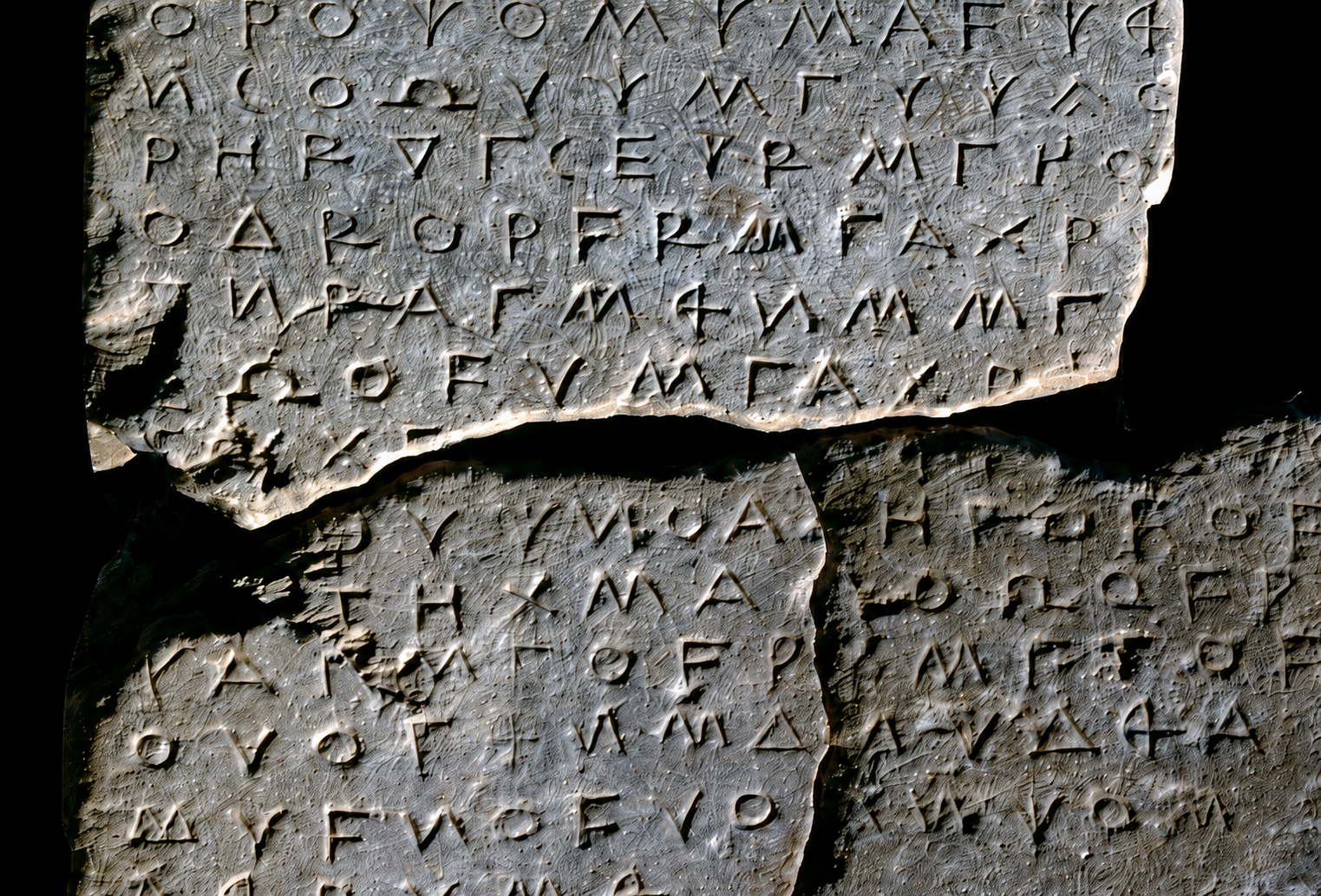
ROSETTA TAŞI ETKİSİ
“Çift Dilli Stel” ile Rosetta Taşı arasındaki en temel benzerlik, her ikisinin de okunamayan bir dilin şifresini çözmek için birer “anahtar” görevi görmesidir.
Konuşma geçmişimizde paylaştığınız bilgilere dayanarak bu benzerlikleri şu şekilde özetleyebiliriz:
Çok Dilli Metin Kullanımı vardır. Tıpkı Rosetta Taşı’nda olduğu gibi, Kaunos’taki stelde de aynı metin iki farklı dille yazılmıştır.
Stelin bir tarafında bilinen bir dil olan Yunanca, diğer tarafında ise çözülmeyi bekleyen Karca yer almaktadır.
Bilinen Dilin Referans Alınması olmuştur. Her iki eserde de araştırmacılar, bilmedikleri dili çözebilmek için bildikleri dili referans noktasıolarak kullanmışlardır.
Çözüm Yönteminin Aynılığı vardır. Her iki keşifte de kişi adları, tanrı adları ve unvanlar gibi özel kelimeler üzerinden karşılaştırma yapılmış, harf harf eşleştirme yöntemiyle bilinmeyen alfabelerin ses değerleri çözülmüştür.
THE ROSETTA STONE EFFECT
Assoc. Prof. Dr. Ufuk Çörtük:
The most fundamental similarity between the “Bilingual Stele” and the Rosetta Stone is that both served as a “key” to deciphering a previously unreadable language.
Based on the information shared earlier in our conversation, these similarities may be summarized as follows:
There is the use of multilingual texts. Just like the Rosetta Stone, the Kaunos stele contains the same text written in two different languages. One side of the stele is inscribed in Greek, a language already understood, while the other is written in Carian, which had yet to be deciphered.
The known language was used as a reference. In both cases, researchers used the language they already understood as a reference point for deciphering the language they did not know.
The decipherment methods were similar. In both discoveries, comparisons were made through distinctive words such as personal names, names of deities, and titles. By matching the texts letter by letter, researchers were able to determine the phonetic values of the previously undeciphered alphabets.
DENİZDEN TUZA:
KAUNOS’UN DÖNÜŞÜM HİKÂYESİ
FROM SEA TO SALT: THE STORY OF KAUNOS’S TRANSFORMATION
“Bir limanın çekilişi…
Bir zenginliğin
doğuşu”
“The Retreat of a
Harbor…
The Birth of Prosperity”
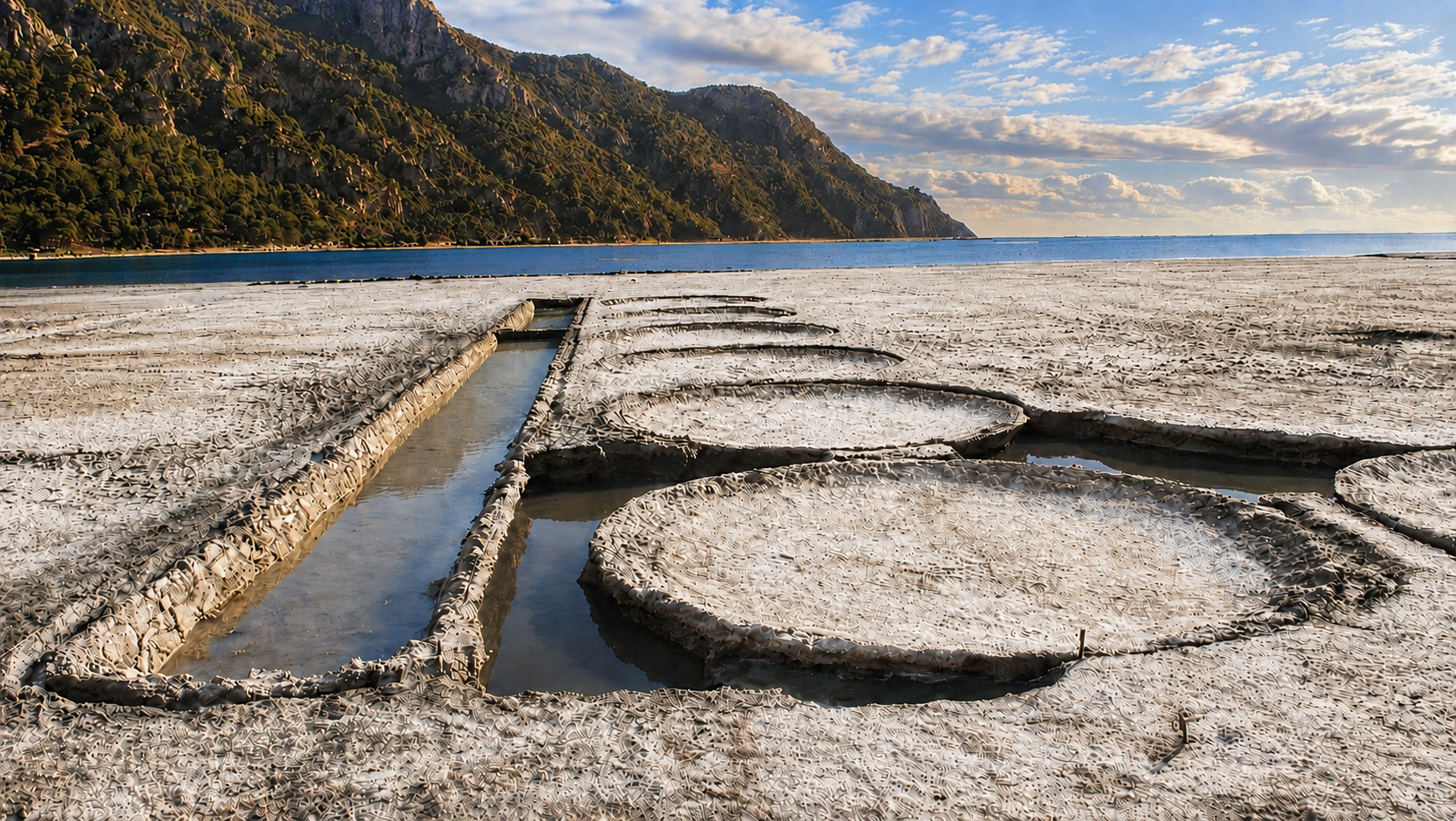
Sunucu: Kaunos Antik Kenti’nin hemen önünde yer alan ve bugün Tuzla Gölü ya da DalyanTuzlası diye bilinen alanın hikâyesi nedir? Antik çağda burası açık bir deniz limanıydı, ne oldu da “tuzla” oldu?
Doç. Dr. Ufuk Çörtük:
Eskiden Kaunos, doğrudan Akdeniz’e bağlı bir liman kentiydi ve ticaret gemileri buraya doğrudangirerdi.
Fakat zamanla Dalyan Çayı’nın taşıdığı alüvyonlar limanı doldurmaya başladı ve kentin denizleolan bağlantısı daraldı.
Sonuç olarak bu alan bir lagün, yani kapalı su havzası haline geldi.
Kapalı havzada suyun buharlaşması arttıkça tuz oranı da yükseldi;
böylece bugün bildiğimiz “tuzla” oluştu.
“Deniz çekildi…
ama Kaunos’un zenginliği kaybolmadı,
biçim değiştirdi.”
Sunucu: Bu oluşum antik dönemde ne işe yarıyordu ve kente ne gibi faydalar sağladı?
Doç. Dr. Ufuk Çörtük:
Tuz, antik dünyada altın kadar değerli bir unsurdu.
Özellikle balık gibi gıdaların saklanmasında, ticarette, vergi sisteminde ve genel ekonomide hayatibir rol oynuyordu.
“Antik dünyada tuz,
yalnızca bir madde değil…
bir güçtü.”
Kaunos özeline baktığımızda, Tuzla liman ekonomisinin harika bir tamamlayıcısı olmuştur. Yani bir yanda liman ve deniz ticareti, diğer yanda tuz üretimi ve saklama faaliyetleri…
Bu iki unsur bir araya gelerek kenti ciddi anlamda zenginleştiriyordu.
Bu durum bize Kaunos’un yalnızca bir liman kenti olmadığını,
aynı zamanda değişen doğa koşullarına uyum sağlayabilen bir ekonomik zekâya sahip olduğunu da gösterir.
“Kaunos’ta ekonomi yalnızca denize bağlı değildi…
doğanın dönüşümüne de uyum sağlıyordu.”
Zaten son yıllarda gün yüzüne çıkartılan bu “Tuzla” yapısı, arkeoloji bilimi için bir ilktir veKaunos’un çok özel buluntularından biridir.
Tuz, antik dünyada altın kadar değerliydi.
Bir liman kayboldu… ama onun yerinde yeni bir zenginlik doğdu.
Presenter: What is the story of the area directly in front of the Ancient City of Kaunos, known today as Lake Tuzla or the Dalyan Salt Pans? In antiquity, this was an open seaport. How did it become a salt pan?
Assoc. Prof. Dr. Ufuk Çörtük:
In the past, Kaunos was a port city directly connected to the Mediterranean, and merchant ships could sail straight into its harbor.
Over time, however, alluvial deposits carried by the Dalyan River began to fill the harbor, gradually narrowing the city’s connection to the sea.
As a result, the area became a lagoon—an enclosed body of water.
As evaporation increased within this enclosed basin, the water’s salinity also rose, eventually creating the salt pans we know today.
“The sea retreated…
but the wealth of Kaunos did not disappear;
it merely changed form.”
Presenter: What is the story of the area directly in front of the Ancient City of Kaunos, known today as Lake Tuzla or the Dalyan Saltworks? In antiquity, this was an open seaport. How did it become a salt-production site?
Assoc. Prof. Dr. Ufuk Çörtük:
In the past, Kaunos was a port city directly connected to the Mediterranean, and merchant ships could sail straight into its harbour.
Over time, however, alluvial deposits carried by the Dalyan River began to fill the harbour, gradually narrowing the city’s connection to the sea.
As a result, the area became a lagoon—an enclosed body of water.
As evaporation increased within this enclosed basin, the water’s salinity also rose, eventually creating the saltworks we know today.
“The sea retreated…
but the wealth of Kaunos did not disappear;
it merely changed form.”
Presenter: What purpose did this formation serve in antiquity, and what benefits did it bring to the city?
Assoc. Prof. Dr. Ufuk Çörtük:
In the ancient world, salt was as valuable as gold.
It played a vital role, particularly in preserving foods such as fish, as well as in trade, taxation and the wider economy.
“In the ancient world, salt was not merely a commodity… it was a source of power.”
In the specific case of Kaunos, the saltworks perfectly complemented the port economy. On one side were the harbour and maritime trade; on the other, salt production and food-preservation activities…
Together, these two elements brought considerable wealth to the city.
This shows us that Kaunos was not merely a port city; it also possessed the economic ingenuity to adapt to changing natural conditions.
“The economy of Kaunos did not depend solely on the sea… it also adapted to nature’s transformation.”
Indeed, this “saltworks” structure, uncovered in recent years, represents a first for archaeology and is one of the most remarkable discoveries at Kaunos.
Salt was as valuable as gold in the ancient world.
A harbour disappeared… but in its place, a new source of wealth emerged
PERİAKTOS:
SAHNENİN GÖRÜNMEYEN GÜCÜ
PERIAKTOS:
THE UNSEEN POWER OF THE STAGE
“Bir dönüş
ve
dünya değişir”
“One turn…
and
the world changes.”
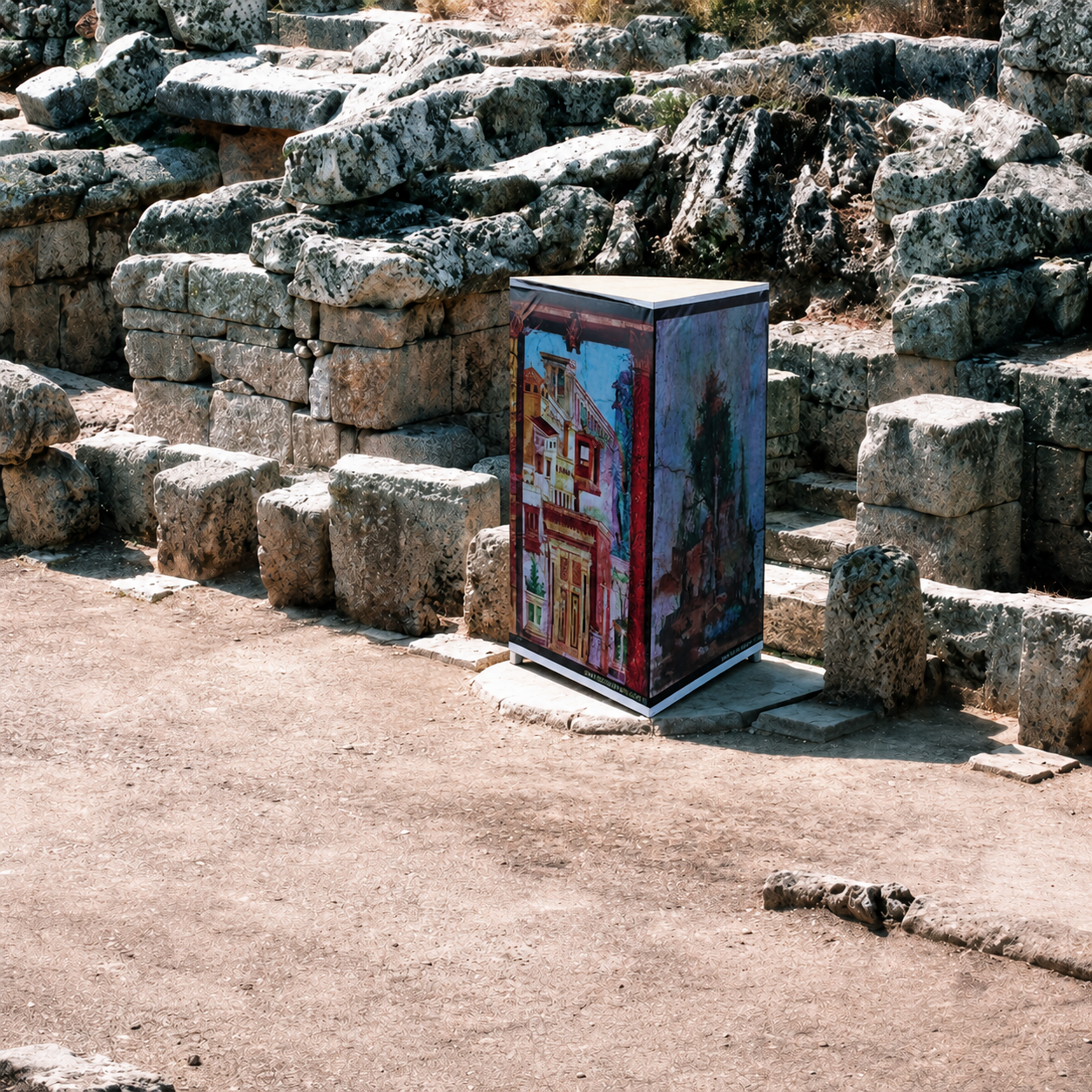
Sunucu: Kaunos tiyatrosundaki “Periaktos” tam olarak nedir ve nasıl çalışıyordu?
Doç. Dr. Ufuk Çörtük:
Kaunos sahnesinde yalnızca oyuncular değil, mekânın kendisi de hareket ederdi.
Bir dönüşle şehir başka bir dünyaya açılırdı.
Bu yüzden Periaktos için “antik çağın görünmeyen yönetmeniydi” diyebiliriz;
çünkü o döndüğünde, hikâye de yön değiştirirdi.
Periaktos, üç yüzlü döner prizma şeklinde bir sahne dekorudur ve her yüzünde şehir manzarası, sarayveya doğa gibi farklı bir sahne resmi bulunur.
Sahnenin yanına dikilen ahşap bir eksen etrafında görevliler tarafından çevrilerek çalışırdı.
Bir çevirme hareketiyle mekân değişir, hikâye başka bir yere geçerdi.
Bunu bugünkü sinemadaki “cut” (sahne geçişi) mantığının antik versiyonu olarak düşünebiliriz.
“Periaktos döndüğünde, sahne değil, hikâye değişirdi, zihindeki dünya değişirdi.”
Sunucu: Peki Periaktos’un Kaunos tiyatrosu için önemi neydi ve seyirciye ne gibi katkılar sağlıyordu?
Doç. Dr. Ufuk Çörtük: Sadece sahne değil, zihindeki dünya değişir.
Kaunos tiyatrosu Hellenistik dönemde inşa edilmiştir ve yaklaşık 5.000 kişilik bir kapasiteye sahiptir.
Bildiğiniz gibi Kaunos’un o karakteristik organik ve teraslı plan yapısının şekillenmesi Arkaik dönemlebirlikte başlamış ve bu süreç Hellenistik dönemin sonuna kadar tamamlanmıştır.
İşte bu gelişmiş dönemde tiyatroda Periaktos’un kullanılması, sadece konuşmanın değil, görsel anlatımında son derece güçlü olduğunu ve Kaunos’ta tiyatronun teknik açıdan ne kadar gelişmiş bir düzeyeulaştığını göstermektedir.
“Kaunos’ta tiyatro yalnızca anlatmaz, seyirciye yaşatır.”
Bu sistem üç temel işe yarıyordu:
Birincisi, bekleme veya kesinti olmadan hızlı sahne değişimi sağlıyordu.
İkincisi, görsel dünya değiştiği için seyircinin zihninde yeni bir atmosfer oluşturarak anlatımıgüçlendiriyordu.
Üçüncüsü ise, kırsaldan şehre veya barıştan savaşa geçişlerde tek bir dönüşle duygusal etki yaratıyor, seyircinin hikâyeye çok daha kolay girmesini sağlıyordu.
“Tek bir dönüş ve seyirci bambaşka bir dünyanın içindeydi.”
Presenter: What exactly was the Periaktos in the Theatre of Kaunos, and how did it work?
Assoc. Prof. Dr. Ufuk Çörtük:
On the stage at Kaunos, it was not only the actors who moved—the setting itself moved as well.
With a single turn, the city opened onto another world.
For this reason, we may describe the Periaktos as “the unseen director of antiquity”; because whenever it turned, the story changed direction as well.
The Periaktos was a rotating, three-sided prism used as stage scenery. Each of its faces displayed a different setting, such as a cityscape, a palace or a natural landscape.
Positioned beside the stage, it was rotated by stagehands around a vertical wooden axis.
With a single turn, the setting changed and the story moved to another place.
We may think of it as the ancient equivalent of the **“cut”—the transition between scenes—**in modern cinema.
“When the Periaktos turned, it was not merely the stage that changed; the story changed, and so did the world in the audience’s imagination.”
Presenter: Why was the Periaktos important for the Theatre of Kaunos, and what did it offer the audience?
Assoc. Prof. Dr. Ufuk Çörtük:
It was not only the stage that changed, but also the world in the audience’s imagination.
The Theatre of Kaunos was built during the Hellenistic period and had a capacity of approximately 5,000 spectators.
As you know, the distinctive organic and terraced layout of Kaunos began to take shape during the Archaic period, and this process was completed by the end of the Hellenistic period.
The use of the Periaktos in the theatre during this advanced phase shows that visual storytelling was just as powerful as the spoken word. It also demonstrates the remarkable level of technical sophistication achieved by the theatre at Kaunos.
“At Kaunos, theatre did not merely tell a story—it made the audience experience it.”
This system served three essential purposes:
First, it enabled rapid scene changes without pauses or interruptions.
Second, by transforming the visual world, it created a new atmosphere in the audience’s imagination and strengthened the narrative.
Third, during transitions from the countryside to the city, or from peace to war, a single turn created a powerful emotional effect and allowed the audience to enter the world of the story much more easily.
“With a single turn, the audience found itself in an entirely different world.”
BİRİNCİ BÖLÜMÜN SONU.
END OF PART ONE